
Source: Dr. Tran BioSci
Summary
- Since September, all three key market indices (XBI, IBB, and DJI) are trading on a downtrend.
- The stock market cycle usually occurs in advance of the economic cycle.
- The current market hiccup is growing stronger by the day thereby, providing more evidence of an incoming bear market and a recession.
- The undisciplined and uninformed investors can suffer catastrophic losses and thereby quit investment altogether.
- Being patience and opportunistic can lead to substantial wealth creation at the turn of the next bull market.
"Beta and modern portfolio theory and the like - none of it makes any sense to me.
We’re trying to buy businesses with sustainable competitive advantages at a low, or even a fair, price."
- Charlie Munger
Since September 2018, it is not far from the truth that we are entering into an aggressive bear market that can potentially transition into a full-blown recession. Most of the major stock market indices are trading southbound. In the past three months, the Dow Jones Industrial Average (DJI), SPDR S&P Biotech ETF (XBI), and iShares Nasdaq Biotechnology ETF (IBB) exchanged hands lower by 17% at $83.24, 11% at $108.50, and 4% at 25635.01, respectively.
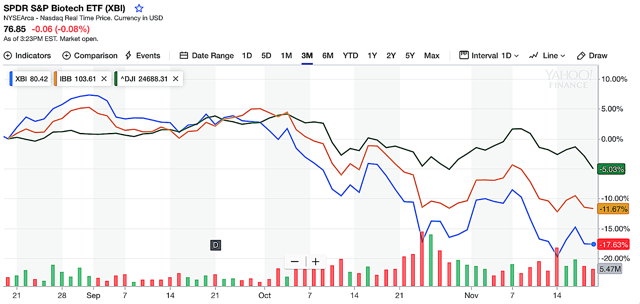
Figure 1: Key market benchmarks (Source: Yahoo Finance)
It’s difficult to pinpoint the exact causality that brought market bears out of the woodwork. Nevertheless, it is likely that the looming fear of a Global Trade War might be the culprit. Another possibility is the interest rate hike by the Fed. To add further injury to the insult, there are concerns regarding the rising dollar. With our interconnected economy, global trade is a key revenue driver for the U.S. Due to a stronger dollar, global trade will suffer which will reduce our gross domestic product ("GDP"). Amidst the panic on Wall Street, we’ll explore strategies for you to in this educational series article.
As follow, we believe that there is no better teacher than experience because his or her lessons are more powerful than any books. That being said, we entered the financial market in 2007 when we were still in our postgraduate education. Our first stock, Darden Restaurants (NYSE:DRI) worked out very well. Nevertheless, the 2008 Great Recession started to hit the market with nearly all financial stocks suffering a meltdown.
That financial crisis all started with subprime lending, in which banks and financial institutions offered mortgage loans to people who were unable to pay it back. Mortgage loans were bundled into a financial instrument known as mortgage-backed security ("MBS") and marketed to investors. As homeowners struggled to pay their mortgage, houses went into foreclosure "en masse." As these toxic loans weighted heavily on the balance sheet of financial institutions, MBS lost most of all their value and the rest is history.
During this crisis, Buffett’s wisdom resonated most strongly in our mind. Per the Oracle of Omaha, "Be greedy when others are fearful and be fearful when others are greedy." As we researched Buffett, we also read the works of other gurus, including Benjamin Graham, John Templeton, Philip Fisher, George Soros, Charlie Munger, and Mohnish Pabrai. After countless hours of self-education, a common theme emerged: there is a huge opportunity for substantial profits amidst the difficulty of the 2008 Great Recession. Notably, this first major event gave birth to our new investment philosophy, Integrated BioSci Investing. It is a fusion of accumulated wisdom from various Founding Fathers that are distilled specifically for the life science industry.
In the coming months, we reread The Intelligent Investor from Buffett’s teacher (Benjamin Graham), and we are convinced that the aforesaid recession is only temporary. Despite that we do not know when it will conclude, we were certain that it is not a matter of "if" but "when&...


































 (All Rights Reserved)