
Dry granulation by roller compaction is a continuous process applied routinely to convert fine, difficult to handle powders into uniform granular products that flow freely and perform efficiently in subsequent manufacturing steps. The advantages of roller compaction include relatively modest capital investment, low running and maintenance costs, and high energy efficiency. Particularly suitable for moisture or heat sensitive materials and those that require ultra-high containment, dry granulation is an important step in the manufacture of pharmaceuticals.
Processing powder blends can present a number of challenges: component powders may be poorly flowing in the process, the blends may be susceptible to segregation, or the formation of agglomerates may affect homogeneity. Granulation is used in a range of industries and applications to combine multiple components of a blend into a more free-flowing, homogeneous intermediate product for downstream processing. It is frequently carried out as a wet process, but the resultant wet mass has to be dried and milled to generate a processable product. This can be time consuming and expensive, and in some cases not possible due to chemical and/or thermal degradation of the active ingredient.
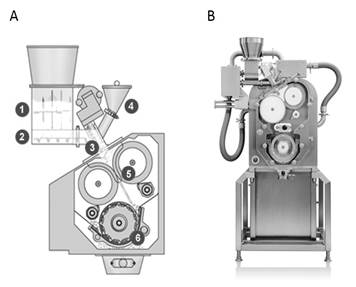
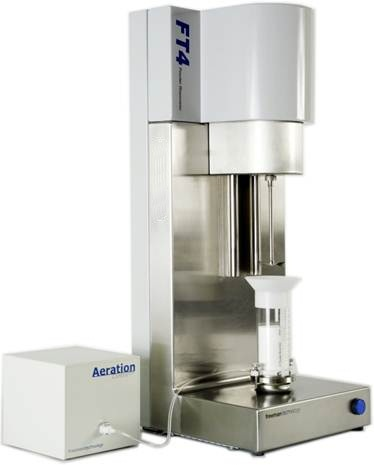
MINI-PACTOR® Roller Compactor FT4 Powder Rheometer®
(Gerteis Maschinen+Processengineering AG, Switzerland) (Freeman Technology Ltd)
Dry granulation has significant benefits in terms of both processing and cost reduction, and can be used with sensitive materials. However, there is little indication of which process parameters produce optimal granulate quality in order to achieve interruption free processing and high-quality products. Most equipment suppliers and product manufacturers therefore rely on historical and ad-hoc trial information to identify suitable parameters.
This application note details the joint study undertaken by Freeman Technology Ltd. and Gerteis Maschinen+Processengineering AG, to investigate how process parameters influenced the properties of the dry granulate of a placebo formulation.
Methods
A placebo formulation consisting of 70% lactose, 29.5% microcrystalline cellulose and 0.5% magnesium stearate was granulated using a Gerteis MINI-PACTOR® roller compactor, on which the Roll Gap, Compaction Force and roller speed can be varied together with the screen/sieve size. The resulting granulates were evaluated using a Freeman Technology FT4 Powder Rheometer® to quantify the dynamic, bulk and shear properties.
The Effect of Compaction Force
Six identical batches of the feedstock were processed in the MINI-PACTOR® at different Compaction Forces:
I | II | III | IV | ... Read More

Related News
Battery manufacturers discover the power of powder testing
PharmaSources.com January 13, 2022 You may like

Supply nitrile rubber suction cup HFG-200 vacuum suction cup spreader high temperature suction cup

Vacuum suction cup hanger steel plate high temperature aluminum plate suction cup titanium plate and other metal plate suction cup under 30 tons
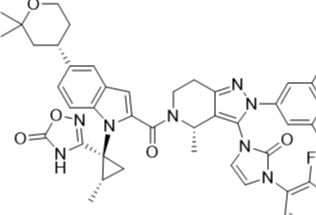
Orforglipron
3 tons of aluminum plate vacuum suction cup hanger can set high quality plate suction cup hanger

Tempered glass suction cup hanger, glass deep processing handling lifting suction cup, glass 90 degree flip suction crane
Get alerted on the PharmaSources E-Newsletter and Pharma Sources Insight E-Compilation! Subscribe
Note: You can unsubscribe from the alerts at any time. Get alerted on the PharmaSources E-Newsletter and Pharma Sources Insight E-Compilation! Subscribe
Note: You can unsubscribe from the alerts at any time. Pharma Sources Insight July 2025: GLOBAL APISOURCING TRENDS

READ ONLINE
DOWNLOAD
Pharma Sources Insight January 2025: What are Reshaping Pharma's Future?

READ ONLINE
DOWNLOAD
Pharma Sources Insight June 2024: Globalization on the Go

READ ONLINE
DOWNLOAD
Pharmaceutical Industry in 2024: Flexible Production, Innovative Drugs and Personalized Medicine

READ ONLINE
DOWNLOAD
PSI April 2023: Innovative Drugs Going Aroad

READ ONLINE
DOWNLOAD
PSI June 2022: New Developments, Greater Imapct

READ ONLINE
DOWNLOAD
PSI APRIL 2022: A Universal Vaccine Against All Variants

READ ONLINE
DOWNLOAD
PSI January 2021: Rolling Out the Vaccines

READ ONLINE
DOWNLOAD
PSI August 2020: The Great Journey or Recovery

READ ONLINE
DOWNLOAD
PSI December 2021: Quantum Revolution in Drug Discovery

READ ONLINE
DOWNLOAD
PSI August 2021: New Medtechs Shaping the Industry

READ ONLINE
DOWNLOAD
PSI April 2021: The Future of Immunotherapy

READ ONLINE
DOWNLOAD
PSI October 2020: Pharma Landscape in China

READ ONLINE
DOWNLOAD
PSI June 2020: A Post-pandemic Future

READ ONLINE
DOWNLOAD
Most popular
Apeloa Pharmaceutical releases first ESG
PharmaSources
May 12, 2025
Basic Concepts and Latest Trends in Radiation Biology: Emerging Insights and Future Directions
Sadia Ajmal
Sep 18, 2025
Methodology Validation in Chinese Pharmacopoeia 2025: How to Report Accuracy and Precision
Xing Xing
Sep 12, 2025
Digitalization in Procurement: From AI Forecasting to Blockchain Traceability
Saher Haider
Sep 19, 2025
Follow Us


Contact Us
About Us
Buy Service
Sell Service
Follow Us


Copyright 2006-2025
 (All Rights Reserved) (All Rights Reserved)Copyright 2006-2025
(All Rights Reserved) |