Product Description
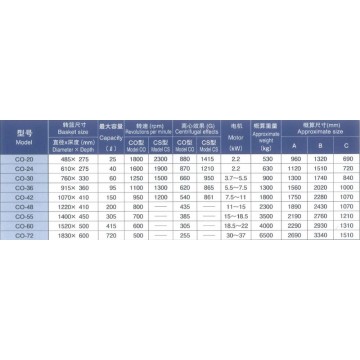
CO
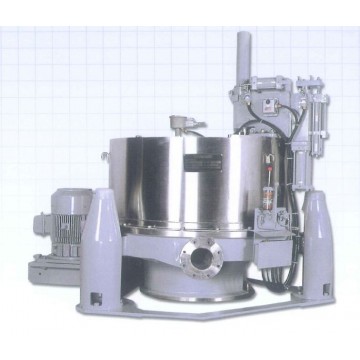
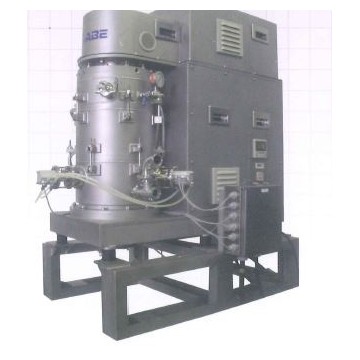
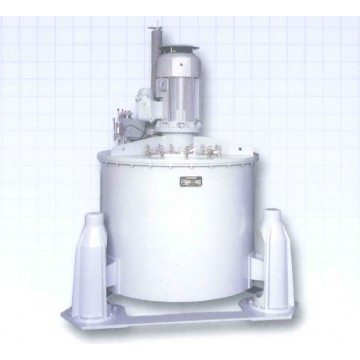
- The basic ode with highest applicability is usable for substance in various areas. The model is rated high for performance, operability, safety and durability.
- Various models, such as those without perforated basket or with skimming device, are available for microparticle treatment.
- Driving systems include the friction clutch system, inverter system and direct motor connection system.
AI Product Description
*The following content is generated by AI and is for reference only.
Based on standard chemical nomenclature and common industrial abbreviations, **CO(CS)** is not a standard or widely recognized chemical formula or type designation in the way that things like "CO2" (Carbon Dioxide) or "CS2" (Carbon Disulfide) are.
However, depending on the context of your inquiry, it likely refers to one of the following three possibilities:
### 1. A Typo for Carbonyl Sulfide (COS)
This is the most chemically probable interpretation if you are asking about a specific gas or compound.
* **Correct Formula**: **COS** (often written as O=C=S).
* **Structure**: It consists of a central carbon atom double-bonded to an oxygen atom and double-bonded to a sulfur atom ($O=C=S$).
* **Properties**: It is a colorless, toxic, flammable gas with a smell similar to rotten eggs. It is structurally analogous to Carbon Dioxide ($CO_2$), where one oxygen is replaced by sulfur.
* **Context**: It is found in volcanic emissions, natural gas, and is used as a reagent in organic synthesis.
### 2. A Confusion with Coordination Chemistry (Carbonyl + Thiocarbonyl)
In organometallic chemistry, **CO** stands for **Carbonyl** (a ligand $C equiv O^-$) and **CS** stands for **Thiocarbonyl** (a ligand $C equiv S^-$).
* If you see a complex described as having both "CO" and "CS" ligands, it might be shorthand for a metal carbonyl-thiocarbonyl complex (e.g., $M(CO)_x(CS)_y$).
* However, there is no single molecule called "CO(CS)" without a central metal atom specified.
### 3. Industrial or Safety Acronyms
In some specific industrial safety contexts (like hazardous material lists), codes can be non-standard:
* **CO**: Carbon Monoxide.
* **CS**: Cyanogen Chloride (rarely abbreviated this way, usually CNCl) or simply "Cyanide/Sulfur" mixtures, though CS is most famously associated with **CS Gas** (Chlorobenzylidene malononitrile), a tear gas.
* **CO(CS)**: This combination does not appear in standard NFPA or UN hazard codes.
### Conclusion
If you are looking for the chemical compound containing Carbon, Oxygen, and Sulfur, the correct formula is **COS (Carbonyl Sulfide)**.
If you encountered "CO(CS)" in a specific document, diagram, or software interface, please provide the **context** (e.g., "in a gas chromatography report," "in a metallurgy paper," or "in a safety data sheet"), as it may be a proprietary code or a specific typo within that source.










 (All Rights Reserved)